How to Fix a Running Toilet Yourself (Before Calling a Plumber)
Quick Answer: How Do You Fix a Running Toilet?
To fix a running toilet, lift the tank lid and check three parts: the flapper, the float, and the fill valve. In about 8 out of 10 cases the cause is a worn flapper — a $5–10 rubber seal you can replace by hand in 15 minutes, with no special tools and no plumber.
Take a breath — this is one of the friendliest repairs in the whole house. Everything inside the tank is designed to be swapped by an ordinary person, and the water in there is clean supply water, not waste. Let’s work through it the same way a plumber would: diagnose first, then fix.
What’s Actually Wrong With Your Toilet? (Diagnosis)
A toilet runs for one reason: water is escaping the tank, so the fill valve keeps refilling it. Your only job is to find where it’s escaping. Lift the tank lid, set it somewhere safe (porcelain cracks easily), and match what you see and hear to this table.
| Symptom | Likely cause | Go to |
|---|---|---|
| Jiggling the handle makes it stop | Flapper stuck open or chain snagged | Fix 1 |
| Runs constantly; water spills into the overflow tube | Float set too high | Fix 2 |
| Runs on and off every few hours (“phantom flushing”) | Worn flapper leaking slowly | Fix 1 |
| Constant hissing, or valve never fully shuts off | Worn fill valve | Fix 3 |
Not sure even after looking? Put 5–10 drops of food coloring in the tank, wait 20 minutes without flushing, and check the bowl. Colored water in the bowl means the flapper is leaking — that’s your answer in four out of five running toilets.
Once you know the culprit, here’s exactly how to fix a running toilet in each case.
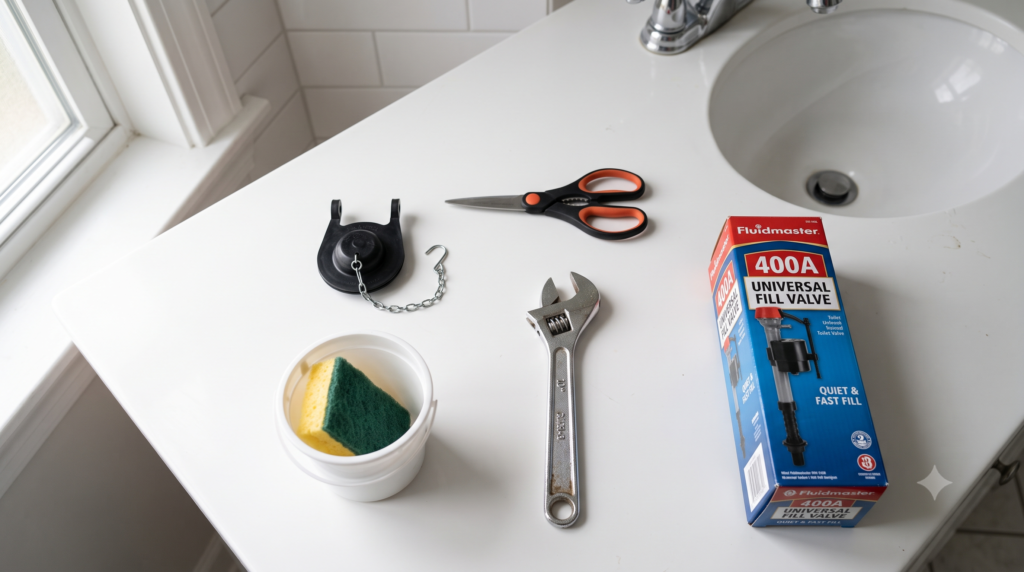
What You’ll Need
- Universal toilet flapper — $5–10 (take a photo of your old one to match size: most are 2″, newer high-efficiency toilets use 3″)
- Fill valve — $10–20 (a float-cup type like the Fluidmaster 400A style fits nearly every modern tank)
- Adjustable wrench or slip-joint pliers — $8–15, only needed for Fix 3
- Sponge and a small bucket — for the last inch of tank water
- Food coloring — a few drops from the kitchen, free
- Scissors or wire cutters — to trim the new flapper chain
Worst-case total if you replace everything: about $25 in parts — still $75–225 less than one plumber visit.
Fix 1: Replace the Flapper 15 MIN · EASY
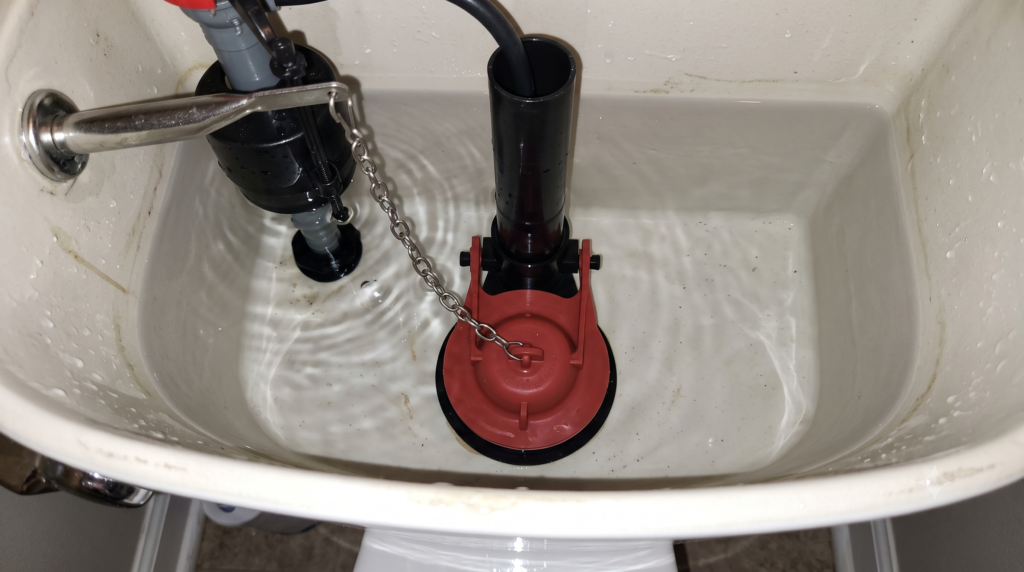
The flapper is the rubber disc at the bottom of the tank that lifts when you flush and seals when the tank refills. Rubber hardens and warps after 4–5 years, and once the seal fails, water leaks into the bowl and the toilet runs. This is the most common running toilet fix, so start here.
- Turn off the water at the oval shut-off valve behind the toilet — clockwise until it stops. Why: you want the tank to stay empty while you work.
- Flush and hold the handle down to drain the tank, then sponge out the last inch of water.
- Check the chain first. If it’s snagged, kinked, or hooked under the flapper, that alone can hold the flapper open. Free it, set about half an inch of slack, and you may be done already.
- Unclip the old flapper from the two pegs on the sides of the overflow tube and unhook the chain from the flush lever. No tools needed.
- Wipe the valve seat — the ring the flapper sits on — with a cloth. Grit or mineral buildup here causes leaks even with a new flapper.
- Clip on the new flapper, attach the chain with half an inch of slack, and trim the excess chain so it can’t tangle.
- Turn the water back on and flush twice to test the seal.
Toilet still running with a fresh flapper? The water level is the next suspect — here’s how to fix a running toilet caused by the float.
Fix 2: Adjust the Float 5 MIN · EASY
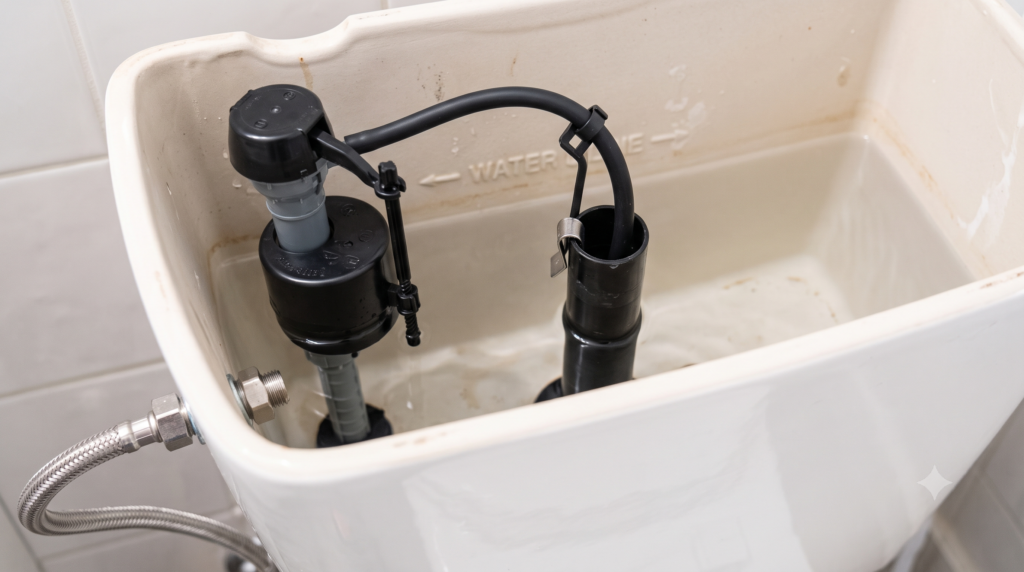
If water is pouring into the overflow tube, the float is set too high, so the fill valve never gets the signal to shut off. The fix is simply lowering the water level — the correct level is about 1 inch below the top of the overflow tube.
- Identify your float type. A float cup slides up and down the fill valve shaft (standard on modern valves). A float ball sits on the end of a long metal arm (older toilets).
- Float cup: turn the adjustment screw or pinch the clip on the side of the valve and slide the cup down half an inch. On screw types, counterclockwise lowers the level.
- Float ball: bend the metal arm gently downward, or turn the screw at the pivot if it has one.
- Flush and watch the refill. The valve should shut off with the waterline an inch below the overflow tube’s rim. Adjust again if needed — small moves, then test.
Level set correctly but the toilet keeps running or hissing? Then the fill valve itself has worn out — the last and biggest fix for a running toilet.
Fix 3: Replace the Fill Valve 30–45 MIN · MEDIUM
A fill valve that hisses constantly, cycles on and off, or refuses to shut off has worn internal seals, and replacement beats repair — a new float-cup valve costs $10–20 and comes with instructions. Don’t let “medium” worry you; it’s four connections, all designed for hand-tightening.
- Shut off the water and empty the tank — flush, hold, and sponge out the rest. Why: the supply line comes off in the next step, and any leftover water ends up on your floor.
- Disconnect the supply line from the underside of the tank. Hand-loosen first; use the wrench only if it’s stuck. Keep a towel underneath.
- Unscrew the plastic locknut under the tank that holds the old valve, then lift the valve out of the tank.
- Set the new valve’s height by twisting its shaft so the top sits at least 1 inch above the overflow tube, then drop it in the same hole.
- Hand-tighten the new locknut underneath — snug plus a quarter turn. Overtightening cracks porcelain, and cracked porcelain is how a $15 job becomes a new toilet.
- Reconnect the supply line and clip the small refill tube onto the overflow tube — above the waterline, not shoved down inside it.
- Turn the water on slowly, let the tank fill, check under the tank for drips, and fine-tune the float as in Fix 2.
When Should You Call a Plumber Instead?
Call a plumber when the problem is outside the tank — everything inside it is fair game for DIY, but these situations aren’t:
- The shut-off valve won’t close or is seized. Forcing a corroded valve can snap it and flood the bathroom. A plumber can replace it safely ($75–150).
- Water on the floor around the base or under the tank that isn’t from your work — that’s a tank bolt, gasket, or wax ring issue, and mistakes there mean water damage.
- You replaced flapper, float, and fill valve and it still runs. The flush valve seat itself may be cracked or pitted, which usually means pulling the tank.
- Cracked porcelain anywhere. No part fixes that; the tank or toilet needs replacing.
- Fair pricing: a straightforward running toilet repair should cost $100–250 including call-out. If you’re quoted $400+ for a fill valve swap, get a second quote.
For the other 90% of cases, knowing how to fix a running toilet yourself is all you need.
How Do You Stop a Toilet Running Again?
- Skip drop-in tank tablets. The chlorine sits against the flapper and eats the rubber years early — it’s the #1 cause of premature flapper failure.
- Replace the flapper every 4–5 years as cheap insurance. It’s $5–10 and 15 minutes, versus 200 gallons a day when it fails quietly.
- Do the dye test once a year. Slow flapper leaks are silent; the test catches them before your water bill does.
- Exercise the shut-off valve twice a year — close and reopen it so it never seizes when you actually need it.
- Keep the water level an inch below the overflow tube whenever you’re in the tank for any reason.
Running Toilet FAQ
- Is a running toilet actually costing me real money, or is it a minor annoyance?
- It’s real money. A constantly running toilet can waste up to 200 gallons per day — over 6,000 gallons a month — which can add $50–100 or more to a monthly water bill depending on local rates. This isn’t a “get to it eventually” repair.
- Why does my toilet run every few hours on its own instead of constantly?
- That pattern is called phantom flushing, and it almost always means a leaking flapper. Water seeps slowly past the worn seal into the bowl, the tank level drops, and the fill valve kicks on to top it up. Replacing the flapper for $5–10 fixes it.
- How do I know if I need a new flapper or a new fill valve?
- Use the dye test for the flapper: put food coloring in the tank, wait 20 minutes without flushing, and if color appears in the bowl the flapper is leaking. If the tank holds color but you hear hissing or the valve cycles on and off, the fill valve is the problem.
- Do I need to turn off the water just to diagnose the problem?
- No — only for the repairs. You can watch the tank and run the dye test with the water on. Before replacing the flapper or fill valve, turn the oval shut-off valve behind the toilet clockwise until it stops, then flush to empty the tank.
You Just Fixed a Running Toilet — And Saved Real Money
That’s the whole job: diagnose with the tank lid off, replace the flapper first, adjust the float second, swap the fill valve last. You spent $5–25 and under an hour where a plumber would have charged $100–250 — and you stopped up to 200 gallons a day from draining onto your water bill.
Next time something drips, hums, or rattles, you know the drill: fix before call.